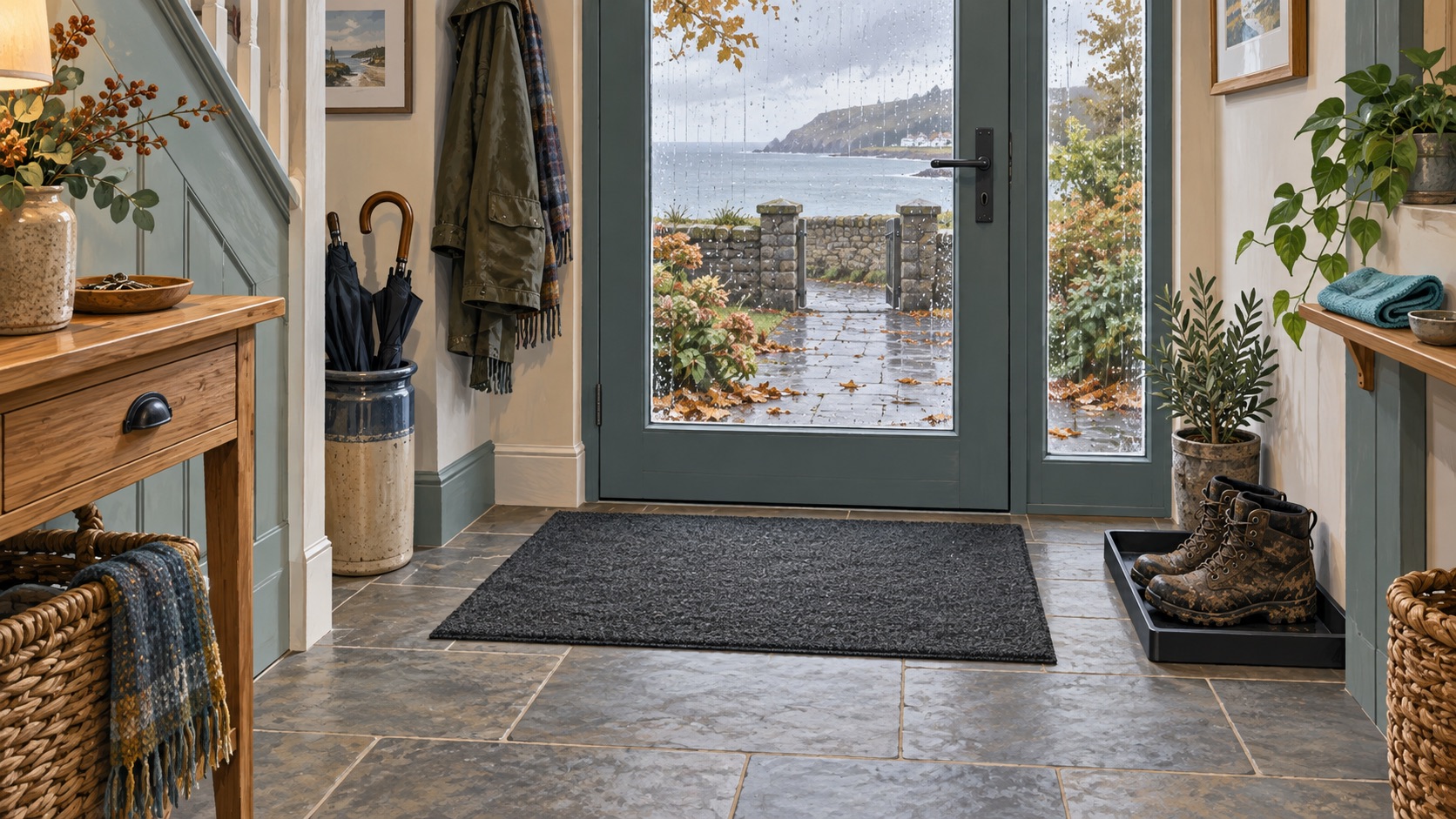
Quick answer: On a wet Isle of Man week, the grit in the hall usually sits under the mat, not on top of it. Lift the mat, clear the step and the threshold, and dry the first metre of floor the mat was covering. Do that before you mop the rest of the hall, or you walk the dirt straight back in.
This is a weekly property-care note for a home you live in. It stays at the door. It does not cover gutters, downpipes, a bin store, or a holiday-let changeover.
What is actually making the hall dirty?
Shoes do not leave the dirt in a neat layer on the mat. They press it through, and they drag back whatever has collected underneath. Leaves and mud on the outside step get walked over the threshold. A coat on the hook by the door drips onto the same square of floor. If you only vacuum the top of the mat, the hall looks briefly better and is dirty again by the evening.
Look at three places before you fetch a mop:
- The floor hidden by the mat.
- The threshold, including the groove a sliding or uPVC door track sits in.
- The outside step, from ground level. Do not go up a ladder, and do not treat this as gutter work.
Lift the mat before you clean anything else
Take the mat up and take it outside. Shake or beat it where the dust will not blow straight back through the door. If it is soaked, leave it outside to drip only if the weather is actually dry. A mat that lives in the rain never dries, and a wet mat holds the grit you have just shaken out.
Then deal with what was underneath. Vacuum or sweep the grit before any water goes down. Mopping a layer of sand turns it into a smear and pushes it into the grain of a timber floor or the joints of a tile.
Check what the floor is before you choose a cloth:
- Sealed tile or a hard floor can take a damp cloth, then a dry one.
- A timber or laminate floor wants the grit gone, then a barely damp cloth, then a dry cloth. Standing water is the thing to avoid.
- Carpet wants a vacuum, not a bucket. If the patch under the mat is damp, lift the mat and let that patch dry before you put the mat back.
If you do not know whether the floor is sealed, use less water, not more.
The threshold is a groove, not a line
The bar under the door collects a ridge of sand, hair and small stones. A broom skips over it. A cloth wiped along the hall side misses the groove that faces outside.
Open the door, kneel, and clear the track with a dry brush or a vacuum nozzle. On a sliding door, stones left in the track are what make the door grind. Pick them out. Do not pour water into the track and hope it runs somewhere useful. Water in a track sits there.
If the threshold is bare timber, keep the cloth dry enough that you are lifting dirt, not soaking the wood. If it is metal or plastic and filmed with mud, a damp cloth and then a dry one is enough. There is no product name in this note, because the finish on your door is the instruction to follow, and a harsh pad will mark it.
The step outside, from the ground
Sweep the step and the paving you stand on to reach the door. Leaves that sit on that step get carried in. This is the step, not the roof, and not the gully at the bottom of a downpipe. If the step itself is green and slippery, note it. Scrubbing a stone step with a stiff brush and water is ordinary care. Climbing to clear a gutter is a different job, and it is not this one.
Shake the mat out here only after the step is swept, or you shake the dirt onto the step you are about to walk on.
Wet coats use the same square of floor
A row of coats by the front door drips onto the mat, or onto the floor if the mat does not reach. Move dripping coats off the floor and onto hooks that are actually over the mat, or leave them in a porch until they stop dripping. Wiping the floor and then hanging a wet coat above it undoes the wipe.
Shoes that are caked belong outside the line of the mat, or in a tray, not on top of a mat you have just cleaned. A tray with a rim keeps the puddle in one place. Empty the tray. A tray that is left full is a second mat, with nowhere for the water to go.
A simple order for a wet week
- Move wet shoes and dripping coats out of the way.
- Lift the mat and take it outside.
- Sweep or vacuum the floor it covered, then the threshold track.
- Sweep the outside step.
- Damp-wipe only the hard surfaces that can take it, then dry them.
- Put the mat back once the floor under it is dry, or leave the mat off until it is.
That order is the whole job. The rest of the hall is a different pass, and it stays cleaner if this one happens first.
What to leave alone
Do not soak a timber threshold to make it look new. Do not use a scouring pad on a polished step, a brass letterbox, or a painted door. Do not pull up a fitted carpet because the patch by the door is darker. Darker carpet by a door is often the traffic, and sometimes it is damp. If the floor under a mat feels wet on a dry day, or the smell stays after the mat has been off, that is a leak or a failed seal to look at, not a reason to mop harder.
A weekly clean can include this door. It does not include roof drainage, and it does not replace a check when water is coming in around the frame. Other property-care notes sit on the CleanCo journal. If you want this door on a regular visit, the quote page is the place to start.
Frequently asked questions
How often should the mat come up?
In a wet spell, once a week is a reasonable rhythm for a home that is lived in. After a storm, or after you have walked builders' dust or beach sand through the door, do it the same day. The top of the mat can be vacuumed in between.
Can I wash the mat in the machine?
Only if the label says so. A coir or natural-fibre mat often wants a shake and a dry, not a wash. A rubber-backed mat that is not meant for a machine can leave the backing in the drum. Read the label, and dry the mat fully before it goes back on the floor.
The hall is still gritty the next day. What did I miss?
Usually the track, or the shoes that went back onto a damp mat. Clear the threshold again and look at the soles you wore after the clean. A mat that was put back while the floor was still wet will print that grit into the floor as it dries.
Is this the same job as clearing the gutters?
No. Stay on the ground, at the step and the door. Downpipes, gullies and the roof are a separate visit.
Does a darker patch under the mat mean the floor is ruined?
Not by itself. It means the mat has been sitting on dirt or damp. Lift it, clean what you find, and let the floor dry. If the patch stays wet, or the floor is soft, stop and find out why the water is there.